
Intervals Nº7: Lily Clark
An interview series with creative professionals exploring music's role in the artistic process.
Intervals is an interview series exploring how music integrates with and informs the creative process. In each installment, I speak with artists across disciplines about the role sound plays in their work and lives.
In today’s conversation, we’re in dialogue with LA-based, multi-disciplinary artist Lily Clark.

I had the pleasure of meeting Lily a couple of years ago at a mutual friend’s house at a dinner party, and have since been wholly enamored with her unique nexus of materiality and physics.
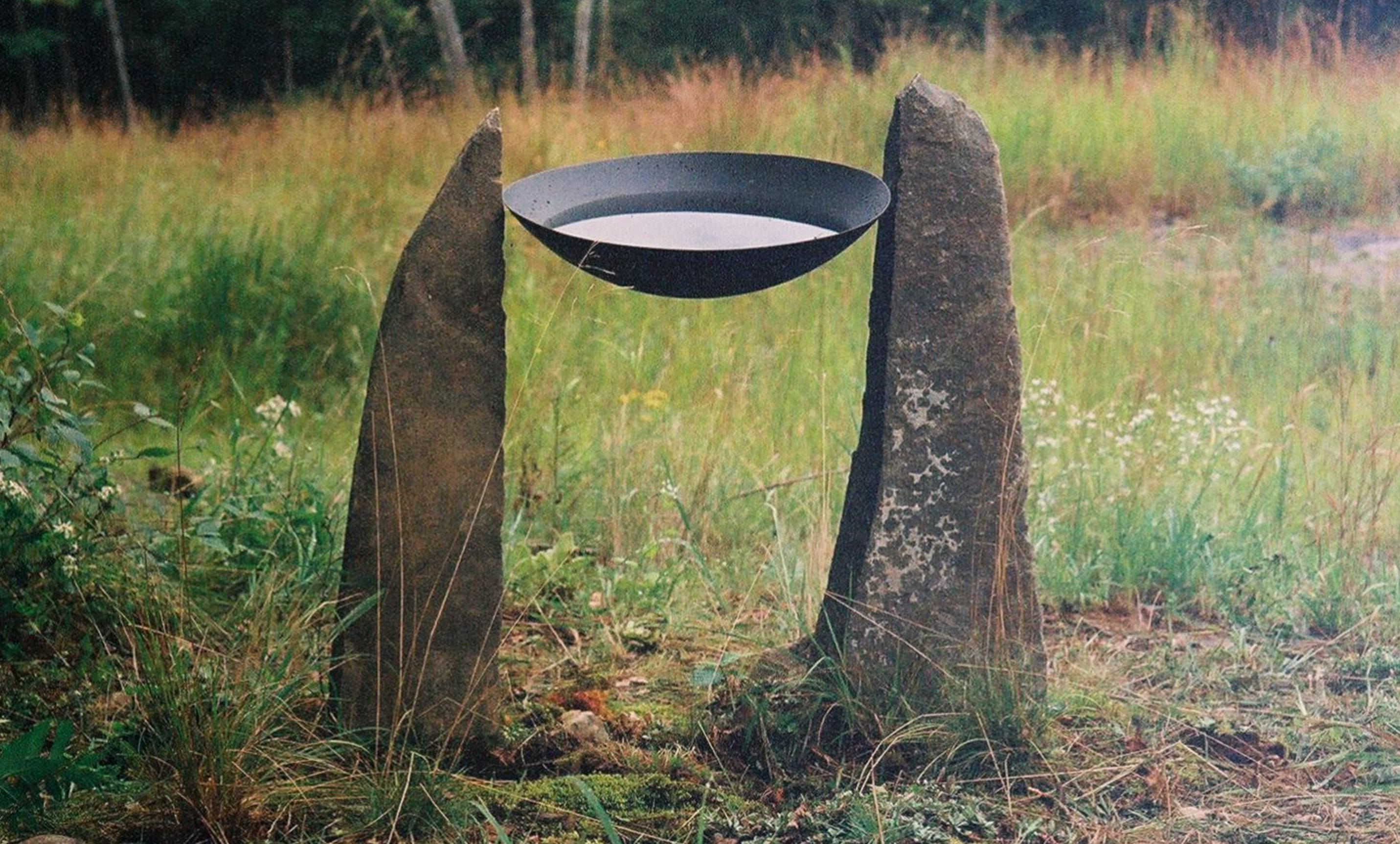
Trained as a ceramicist, Clark’s oeuvre lies in the exploration of fluid dynamics. Through her stone and metal sculptural works, she seeks to illuminate the fundamental nature of water and its relationship with landscape and architecture.
On a casual browse through Clark’s project archive on her website, one easily can glean the stark beauty in the work’s design and presentation. To witness the tactility and dynamism of this work in person is another sensation entirely.
Her ability to harness and control the medium of water feels at once natural and other-worldly. The attention to detail in the material construction partnered with her sleek aesthetic approach allow space for the central fluid element to be both brazenly constant and forever in flux.
Clark’s work has been featured in a host of installations, including exhibitions, commissions and residencies in Japan, Italy, Upstate New York, Walt Disney Concert Hall, Neutra VDL & Marta in Los Angeles and her 2025 show at Antica Terra in the Willamette Valley, among others.

1. What role does music play in the conceptual phase of a project? Music helps me to speed up or slow down certain aspects of each project cycle. I shift between phases of little to no music while conceptualizing a project, and other times when I have music on full volume. Usually very repetitive melodies: disco, cumbia, and ambient music are playing.
2. Has music ever informed creative choices or shifted how you thought about a project? I think of music less as inspiration and more as a tool for regulating mood and energy. It works like punctuation between moments in time. Those shifts happen daily as I move between high and low energy, but they also unfold on a larger, more cyclical scale.
Because I tend to listen to only a handful of songs at once, sometimes even a single song on repeat, hearing it again later immediately brings me back to a very specific period in my life. That kind of transport can be useful, a way of revisiting the thoughts and interests that shaped that moment.
On a very practical note: when I’m actively making substantial creative choices, large decisions, or even when drafting emails, I prefer silence.

3. What are your day to day listening habits? I usually listen to Cali 93.9 on my way to my studio and while running errands. While I’m in my studio, my listening habits are kind of looping or spiral-shaped. I’ll have long stretches, weeks at a time, listening to just a handful of the same songs, then a silent period with no music, and then a very research heavy time. It comes in cycles, as a burst of inspiration every few weeks.
4. What are a few of the most influential artists or albums in recent memory that have provided deep inspiration for your own work? Super Éxitos Vol. 1 by La Sonora Dinamita. Year after year, I keep returning to Sonora. The song “Oye,” would be my favorite from this album. The chorus translates to: “Open your eyes, look up, enjoy the good things in life.”
5. Are there any parallels in your work that relate to music, materials, elements, or patterns that could be interpreted as somehow musical? Water holds an enormous amount of sonic potential. It’s a bit daunting to me in that way (one day I’ll get to it!). But with very simple means, or interventions, it can produce a wide spectrum of tones and rhythms.
Right now, I don’t consider sound to be a central focus of my practice, so I’m always surprised with the final sound of a work. Of course, I predict how it will sound but it’s always a bit different than you imagine. While installing my recent show at Ghebaly, I really heard the piece for the first time; bouncing off the walls of the space as the water hit a shallow stainless steel basin. It almost sounds like a single droplet falling to the bottom of a well.
I was in Kyoto earlier this year, where I finally visited my first suikinkutsu. As part of the tea ceremony, you dip your hands into the wash basin. The suikinkutsu becomes activated by the falling droplets, creating a tinkling cacophony of sound underground. Upturned metal bowls are sunken underground, finely tuned to produce a pleasing, bell-like melody. Experiencing it in person clarified how little intervention is needed for water to become musical.
6. Favorite film soundtracks or scores: Michael Nyman, The Piano and David Appleyard, Picnic at Hanging Rock
7. Is there a song or artist from your youth that encapsulates that time in your life? According to last.fm, I was mostly listening to Grouper and Broadcast in high school. I think at the time I gravitated towards female vocals that felt slightly melancholic and restrained.
But I also spent a ton of time going to live shows at The Smell, Echo Curio, and Pehr Space here in LA. I have some nostalgia for late 2000s garage/punk rock in LA: No Age, Mika Miko, and Bleached to name a few.
8. A track currently on repeat: “Tra Tra” by Mala Fe
9. Last truly amazing live performance: Kali Malone at the First Congregational Church in Los Angeles.
10. How do you find out about new music? I don’t have a very systematic approach. It mostly depends on how I stumble into things. Sometimes it’s through the radio, sometimes via Spotify recommendations, or sometimes by going down a rabbit hole into a very specific genre and following that thread for a while.

Intervals Nº7 Playlist: Spotify, Tidal
Clark’s most-recent exhibitions were both in California: a group show at Blunk Space in Point Reyes Station and Dew Points, at François Ghebaly in Los Angeles.
From Ghebaly: “Clark delicately suspends a roughly hewn alabaster boulder at the center of the room. The seemingly weightless rock is poised above a recipient steel basin, and releases water in slow, singular droplets. Upon reaching the basin, each droplet creates outward ripples, and as surface tension tries to flatten them back out the ripples return inward…the works ruminate on time, erosion, and reflection, tracing the cyclical forces of gravity and how they shape our materiality, landscape, and inner terrain.”
More on Lily and her work at lily-clark.com & @lilyyill.
More discussions from the INTERVALS series:
love these artist interviews because they're opening up my eyes to the wide range of work being done out there.